Used Machines that we sell DAP (Delivered At Place)
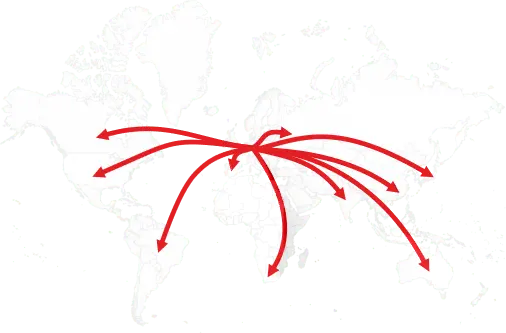
Incoterms 2010 defines DAP as 'Delivered at Place' – the seller delivers when the goods are placed at the disposal of the buyer on the arriving means of transport ready for unloading at the named place of destination. Under DAP terms, the risk passes from seller to buyer from the point of destination mentioned in the contract of delivery.
Once goods are ready for shipment, the necessary packing is carried out by the seller at his own cost, so that the goods reach their final destination safely. All necessary legal formalities in the exporting country are completed by the seller at his own cost and risk to clear the goods for export.
After arrival of the goods in the country of destination, the customs clearance in the importing country needs to be completed by the buyer, e.g. import permit, documents required by customs and etc., including all customs duties and taxes.
Under DAP terms, all carriage expenses with any terminal expenses are paid by seller up to the agreed destination point. The necessary unloading cost at final destination has to be borne by buyer under DAP terms
Premium CNC Machine for Heavy Crankshaft & Engine Component Production
Maximize your production capacity with this highly specialized, German-engineered RASOMA FZS 3200 Deep-Hole Drilling Machine. Specially developed by the NSH… Mehr erfahren
We offer an exceptional opportunity to acquire premium European flat glass processing technology from the closed production facility of Doering Glass, Germany.
This inventory represents a comprehensive selection of industrial… Mehr erfahren
High-Quality CNC Tube Bending Machine transfluid DB 642-CNC-R/L for Sale – Fully Automated & Like New
Are you looking for a reliable, high-precision, and fully automated solution for tube processing?
We are offering a first-class… Mehr erfahren
Used ONAPRES 800-Ton Hydraulic Press for sale
This technical documentation describes a hydraulic deep-drawing press manufactured by ONAPRES (Fagor Group). The machine is a single-column, double-acting hydraulic deep-drawing press,… Mehr erfahren
Used Husky E 3150 RS 170/155 Automotive injection moulding machine for sale cheap
Build 1996
Machine zyklen liegen bei 1.402.000
Technical Data Husky with 3150 tons
CNC Control: SIEMENS SIMATIC C7
Injection Unit Screw Diameter… Mehr erfahren
COMPLETE Used production line for COSMETICS and PERFUMERY jars, bottles, caps and containers from raw material to finished decorated product
Products:— Polypropylene (PP) jars (brand: Tarrosalba)— PET and HDPE bottles (brand:… Mehr erfahren
Used Sacform AGM-line Coil Cut to Length Line for sale.
Processes stainless steel 0.5-2mm thick, 1600mm wide. Includes 10T decoiler, straightener, servo feeder, shear, and stacking unit. High-quality, automated system
AGM-… Mehr erfahren
2011 Used AXA VHC 3 XTS 50 5-Axis Machine Center with robot loading
Programmlauf ca. 87539 StundenVerfahrwege:X-Achse 3.000 mmY-Achse 900 mm horizontal/vertikalZ-Achse 850 mm horizontal / 790 mm vertikalB-Achse Arbeitsspindel ± 100°… Mehr erfahren
Used KITAMURA Mycenter-HX300iG/400 Horizontal High-Precision Machining Center
Operating Hours: 21,731 hrsCNC Control Fanuc Arumatik-Mi Control
Technical Specifications
Dimensions: 12.0" x 12.0" (305 x 305mm)
Axis Travel (X, Y, Z):… Mehr erfahren
Used DECKEL MAHO DMC 60 U dualBlock 5-axis machine with 2 pallets
CNC control: Heidenhain TNC 530 i
Operating hours: 78,731 hours
Spindle: 33,322 hours
Technical specifications for the DMG DMC 60 U duoBlock:
Travels:
X-axis: 600… Mehr erfahren
Used HEXAGON Global Classic 07.10.05 - Coordinate Measuring Machine (CMM)
Last Calibration 03/2023
Calibration in accordance with ISO 10360-2:2001.
Machine meets manufacturer's specifications in accordance with ISO 10360… Mehr erfahren